


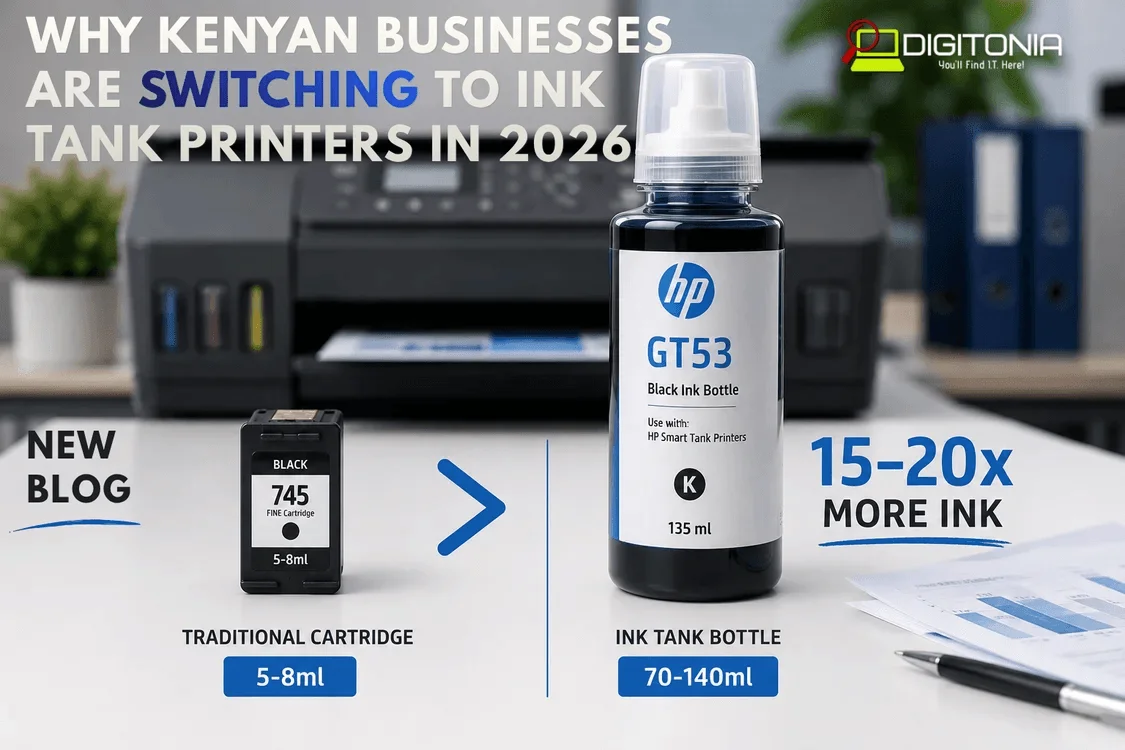
There is a printer in almost every Kenyan office. And in most of those offices, that printer is quietly costing more than anyone realizes.
Not the printer itself. The ink.
The cartridge model has been the default for decades, and it works on a simple but expensive logic: sell the printer cheaply, then make the real money on replacement cartridges. A standard black inkjet cartridge holds between 5 and 8ml of ink. A comparable ink bottle for an ink tank printer holds 70 to 140ml which is roughly 15 to 20 times more ink for around the same price or less. The difference in cost per page is dramatic, and it compounds every single month.
Kenyan businesses are starting to notice. And more importantly, they are doing the maths.
The Cartridge Problem, Explained
Most buyers focus on the price of the printer when making a purchase decision. That is the wrong number to look at.
The right number is the total cost of ownership: what the printer costs you over its entire useful life, including every cartridge, every ink bottle, every replacement, and every moment of downtime when the ink runs out at the worst possible time.
A typical cartridge-based inkjet printer costs between Ksh 8,000 and Ksh 15,000 upfront. It looks affordable. But a single set of replacement cartridges: black and color can be quite costly. For a Kenyan office printing 300 to 500 pages per month, those cartridge costs stack up to a significant annual expense.
The cost per page on a standard inkjet cartridge runs at roughly Ksh 12 to Ksh 20 per black page and significantly more for color. Ink tank printers bring that down to under Ksh 1 per black page. For a business printing 400 pages a month, that difference alone saves tens of thousands of shillings over a year.
What Is an Ink Tank Printer?
An ink tank printer replaces the traditional cartridge system with a set of refillable tanks built into or attached to the printer body. Instead of buying a sealed cartridge with a tiny amount of ink, you buy a bottle of ink and refill the tank directly. The bottles are large, the ink is cheap per millilitre, and the page yield per fill is dramatically higher than any cartridge alternative.
The print head in an ink tank printer is permanent — it stays with the machine for its lifetime rather than being replaced with each cartridge. This means you are paying for ink and ink only, not the packaging, chip authentication, and delivery mechanism that makes cartridges so expensive.
The result is a printer that costs more upfront but costs significantly less to run over time — with a break-even point that, for most Kenyan small businesses printing over 200 pages a month, arrives within the first year of ownership.
The Kenyan Business Case
Kenya’s printing environment has specific characteristics that make ink tank printers particularly well-suited to local business needs.
- Procurement cycles favor predictability. Many Kenyan SMEs, NGOs, and institutions operate on quarterly or annual procurement cycles. Ordering ink bottles in bulk is simpler and more cost-effective than managing multiple cartridge SKUs across different printer models. The Digitonia Printer and Consumables Supply Contract was built for exactly this scenario.
- The counterfeit cartridge problem is real. Kenya’s market has a significant supply of counterfeit and grey market cartridges that damage print heads and void warranties. Ink tank printers use bottles with key-coded nozzles and standardized fill points, which are harder to counterfeit and easier to verify.
- Running costs matter more than upfront costs for growing businesses. A startup or SME that buys a cartridge printer to save money today will often spend more in the first year than if they had bought an ink tank printer from the start. For businesses thinking beyond the immediate purchase, the economics strongly favor ink tanks.
The Options: Which Ink Tank Printer Is Right for Your Business?
Not all ink tank printers are built the same. The right choice depends on your print volume, team size, and whether you need wireless connectivity, duplex printing, or document handling features like an automatic document feeder.
Here is how the current range at Digitonia maps to different business needs:
HP Smart Tank 581 — For the Essentials at an Accessible Price
The Smart Tank 581 is the entry point into HP’s ink tank range: a compact, affordable all-in-one that prints, scans, and copies using HP’s refillable tank system. It is the right starting point for a home user, freelancer, or very small business that wants the long-term cost benefits of ink tank printing without a large upfront investment.
HP Smart Tank 670 — For Home Offices and Small Teams
The Smart Tank 670 steps up with wireless connectivity, automatic duplex printing, and a recommended monthly volume of 400 to 800 pages. Its refillable tanks deliver up to 4,000 pages from a black ink bottle and up to 8,000 pages per colour. Dual-band Wi-Fi, AirPrint, and HP Smart app support make it easy to print from any device in the office or at home.
HP Smart Tank 750 — For Busier Offices That Handle Multi-Page Documents
The Smart Tank 750 adds a 35-sheet Automatic Document Feeder, a larger 250-sheet paper tray, faster print speeds of up to 15 pages per minute in black, Gigabit Ethernet, and a 2.8-inch LCD display. For a small office that regularly scans, copies, or prints multi-page documents like contracts, reports, proposals, and invoices, the ADF alone saves significant time. Its duty cycle of up to 5,000 pages per month means it handles busier environments without strain.
Epson EcoTank L3210 — For Budget-Conscious Buyers Needing the Basics
Epson’s entry-level ink tank all-in-one delivers print, scan, and copy with a page yield of up to 4,500 pages black and 7,500 pages color per ink set. Compact, reliable, and priced for accessibility: the right starting point for home users, students, and very small businesses.
Epson M3140 and M3170 — For Offices That Print Mainly Black and White
Not every business needs color. Law firms, accounting offices, logistics companies, and schools that print primarily text documents benefit from a dedicated monochrome ink tank printer: faster black-and-white output, lower cost per page on black, and a simpler ink supply to manage. The Epson M3140 and M3170 are built for exactly this use case, delivering high-volume black-and-white printing with ink tank economics.
Canon GX6140 — For High-Volume Color Printing
Canon’s GX6140 is a MegaTank printer designed for offices where colour output volume is significant. Large ink capacity, network connectivity, and a high duty cycle make it a strong fit for design studios, marketing teams, and any business that regularly prints colour reports, brochures, or presentations.
Brother T530DW, T730DW, T830DW, and T930DW — For Teams That Need Reliability at Scale
Brother’s ink tank printer range is built for office environments that demand consistent, high-volume output. The T530DW is the entry point, suitable for small teams. The T730DW, T830DW, and T930DW step up progressively in speed, paper handling, and connectivity — with the T930DW representing Brother’s most capable ink tank offering for larger teams or busier office environments.
Brother has a strong reputation for build quality and reliability in professional settings, and their ink tank range brings that same durability to a low-cost-per-page printing model. For businesses that have previously relied on Brother laser printers and want to reduce running costs, the ink tank range is the natural next step.
A Simple Cost Comparison
The numbers below are illustrative, based on typical print volumes and ink costs in the Kenyan market.
| Scenario | Cartridge Printer | Ink Tank Printer |
| Monthly print volume | 400 pages | 400 pages |
| Estimated cost per black page | Ksh 15 | Ksh 1 |
| Monthly ink cost | Ksh 6,000 | Ksh 400 |
| Annual ink cost | Ksh 72,000 | Ksh 4,800 |
| Annual saving with ink tank | — | Ksh 67,200 |
For a business printing 400 pages a month, the annual saving from switching to an ink tank printer is enough to cover the cost of the printer itself — and then some. The higher the print volume, the faster the return on investment and the greater the long-term saving.
When a Cartridge Printer Still Makes Sense
Ink tank printers are not the right choice for every situation. If your business prints fewer than 50 to 75 pages a month, the upfront cost premium of an ink tank printer takes longer to recover, and the ink in the tanks can dry out from lack of use. For very light, occasional printing, a basic cartridge printer remains a practical option.
The decision comes down to print volume. Under 100 pages a month: cartridge is fine. Over 200 pages a month: ink tank almost always wins on total cost of ownership.
Making the Switch
Switching from a cartridge printer to an ink tank printer is a one-time decision that pays dividends for years. The transition is straightforward: most ink tank printers are plug-and-play, and the refilling process is simpler and cleaner than most buyers expect, with key-coded nozzles and spill-resistant bottle designs across the HP, Epson, Canon, and Brother ranges.
For businesses managing multiple printers or looking to consolidate onto a single ink supply model, Digitonia’s Printer and Consumables Supply Contract ensures your ink bottles arrive before you run out: no emergency orders and no printing interruptions.
Ready to make the switch?
Our team at Digitonia will help you find the right ink tank printer for your print volume, team size, and budget.
📲 WhatsApp or call 0795 920 902 for a recommendation and quote. 🌐 Browse our full printer range at digitonia.co.ke

Leave a comment
You must be logged in to post a comment.